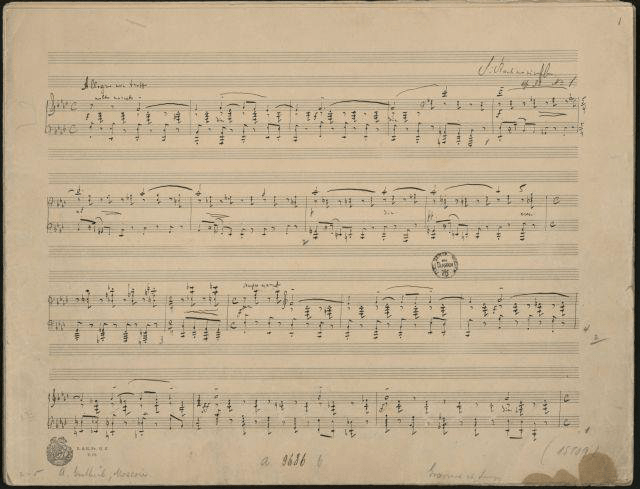
I’ve recently undergone an intense study of Rachmaninoff’s Etudes-Tableaux. To be sure, I’ve listened to these pieces for many years, but I’ve never studied them properly, with the score on the piano rack and my hands on the keyboard. Future posts will enumerate many of my personal revelations about Rachmaninoff’s 17 essays in the etude genre, but for now I’d like to focus on one peculiarity that this and other bodies of work constantly remind me of: Greatness demands Humility.
This is not some attempt to write the first chapter of the next business-oriented self help book. When I say “Greatness demands Humility”, I don’t mean that “leaders eat last” or some other corporate platitude. I mean that in order to adequately confront the particular greatness of a work or idea, one must also confront the comparative mundanity in oneself.
Rachmaninoff composed his two sets of etudes between 1911 and 1917, the last of which were completed shortly before he left Russia for good. These etudes are over 100 years old. Yet I have only recently (within the past few weeks) discovered moments of brilliance in them that have been there all along.
To put this in perspective, I have distinct and humorous memories of being 4 years old and pretending to be Optimus Prime while running around in my very special He-Man themed underwear. It was Heaven manifest when mom made tacos for dinner. I spent my summers outside, closing each day with that familiar lullaby of a slight sunburn and the faint smell of chlorine in my nose. And all that time, Rachmaninoff’s etudes were out there.
Later, my interests would graduate to more “adult” pastimes. I was no longer a robot disguised as a truck; I was a pilot in an F-16. I marched around in my grandfather’s musty WWII overcoat and read about submarines. Gary Paulsen’s Hatchet was a favorite book of mine. The chlorine and the sunburns remained, of course. But the etudes-tableaux were still out there.
In my childhood, the arts were peripheral. There were the fun “oldies” that my dad listened to, the embarrassingly time-bound songs from my sister’s stereo (Listen up, everybody, if you wanna take a chance…), the hackneyed sentimentality of contemporary church music (sorry), and the childish twaddle in my piano method books. But it was all incidental — I didn’t seek it out. I took piano lessons, but only out of a sense of cultural obligation. I took art lessons, but only so I could draw ships and jets and trucks. And for all of that time, Rachmaninoff’s etudes existed, stubbornly refusing death just because I didn’t know about them.
And that’s where the humility sets in. Replace Rachmaninoff with any Old Thing. It could be Shakespeare, or Austen, or Beethoven, or the Sistine Chapel, the book of Romans, the horror of Poe, or the insight of Dickens. It could have nothing to do with Man: the Grand Canyon, or the mighty Mississippi, or even the magisterial oak I’m facing as I type this. They’ve all been here the whole time I’ve been alive.
It is this regularly occurring epiphany that causes me to dismiss wholesale any notion of relativism when it comes to artistic greatness or beauty. If it is in the nature of a thing to be beautiful or ugly, then that beauty or ugliness is there from the beginning, not merely once I come along and offer my little judgments. To say that a thing is great because I deem it great is to exercise at the height of hubris.
When I sit with Rachmaninoff and work out the puzzles he set forth in his etudes in order to re-animate the music, I chuckle at my own insignificance. He brings to life certain complex emotions with such lucidity that I can’t imagine living without his music, but there was a time when I did. And I lived without his music not because it didn’t exist, but because I just didn’t know about it yet.
The same is true of literature, poetry, and the visual arts. I well remember the first time I read from Alexander Pope these lines:
Fired at first sight with what the Muse imparts,
In fearless youth we tempt the heights of arts,
While from the bounded level of our mind,
Short views we take, nor see the lengths behind;
It made so much sense to me! I had felt this very sentiment, however inchoately, for a very long time. How had I survived without his succinct wisdom? But it had been there all along, waiting indifferently for me to discover it.
Yes, there are things yet to be written whose truths will take me by the nape. In twenty years, I may be able to write again about something new. But for everything yet to be created, there are dozens yet to be discovered. Studying Rachmaninoff this summer has brought me to this ultimate question:
What else has been here all along that I haven’t experienced yet, and how will my life change once I’ve found it?
 Classical Connections
Leave a comment