The Story
When Nicolo Paganini (1782-1840) stepped onto the concert stage, he looked every inch a walking skeleton. Years of chronic illness and primitive treatments had turned his once-luxurious, long hair into a stringy, mangy mess. His eyes were sunken into their sockets and what was left of his bottom jaw (his teeth had long since rotted away) barely held his violin in place. Emaciated and pale, his appearance confirmed what his highly superstitious audiences believed: he had condemned his soul to the devil in exchange for supernatural virtuosity. It was an image he cultivated (his name means “little pagan”, after all) from his dress to his mannerisms and even to the music he composed.
His 24 Caprices for solo violin culminate in a tour de force of playing technique, a theme followed by eleven variations of immense difficulty. A variation set like this would usually involve twelve variations, but perhaps that was too holy a number for Paganini. The theme for this caprice became Paganini’s most well-known work and would spend the next hundred years serving as a musical simulacrum of man’s fight with the devil. The allure of the theme enticed many composers to try their hands at other variation sets.
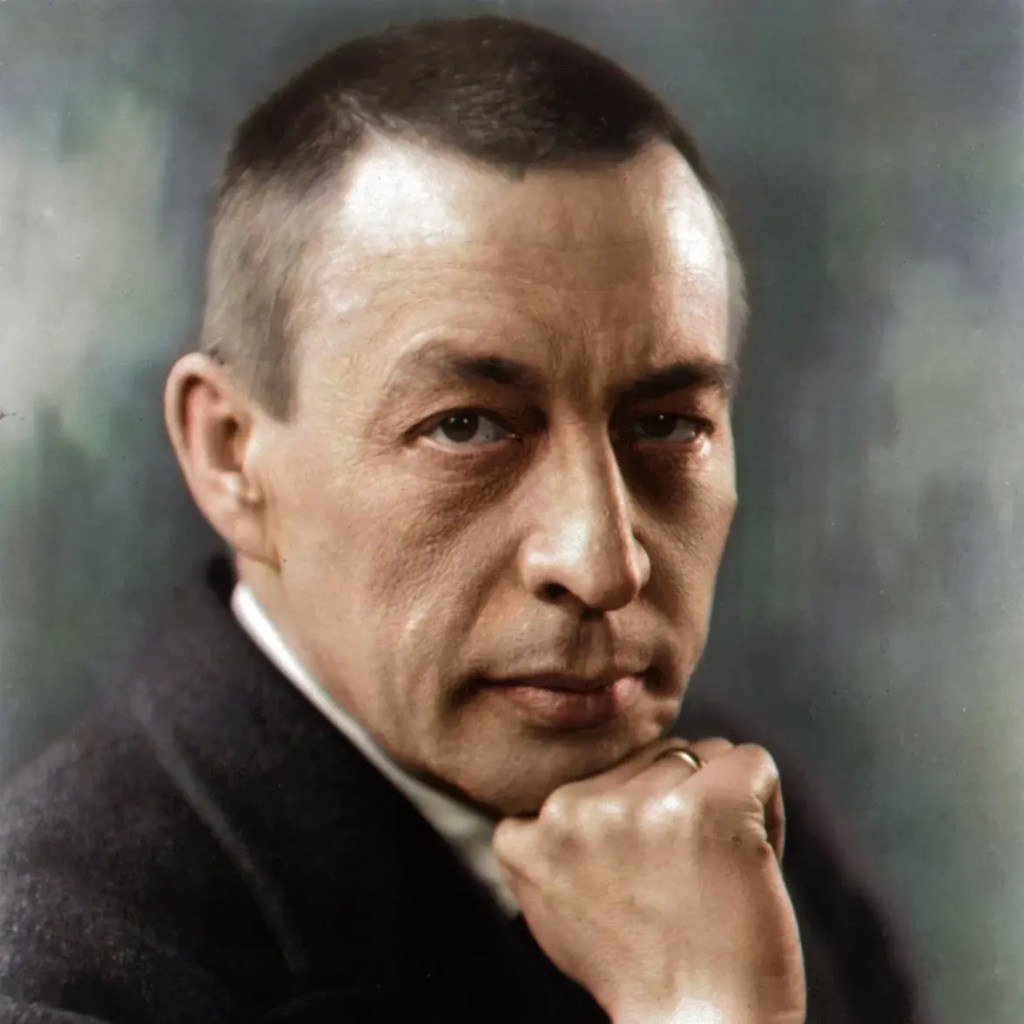
One such composer was Sergei Rachmaninoff (1873-1943), the last great Romantic. When he walked on the stage, he exuded a calm introversion. His short hair and impeccable suits made him look like a rehabilitated convict, or so the critic Harold Schonberg tells us. His extraordinary playing was the result of hard work, not Faustian deals with the devil. Rachmaninoff had long been lionized as one of the greatest pianists of his generation, and in 1934, he composed a blazing set of 24 variations on Paganini’s devilish theme, the Rhapsody on a Theme of Paganini, Op. 43. The eighteenth variation from this work would, in turn, become one of his most well-known pieces.
Two identities wrapped up in the same music, but both saying something completely different.
The Music
Listen first to the Paganini original for solo violin (0:00 to 0:15 of this recording). Then, turn your attention to the Rachmaninoff. Be aware that the eighteenth variation proper begins at 0:19 in our recording. It is the purpose of variation form to explore strange new worlds in the context of a theme, and that often means that the theme hides itself in the process. However, you may be wondering, “What does this piece, beautiful though it is, have anything to do with Paganini’s original?” After all, the two pieces do not, on the surface, sound as though they have anything in common. But that is where Rachmaninoff shows his greatness. His variation is the Paganini theme, but Paganini inverted.[*] He generates his main musical idea by turning the original theme upside down, and, in so doing, gives us a glimpse of beauty in a fallen world.
When the orchestra enters at 1:11, keep in mind that the string section often serves as a kind of Greek chorus, commenting on the experiences of other performers. The whole ensemble is celebrating this new worldview which the pianist has uncovered. Rachmaninoff even casts this variation in the warm key of D-flat major, miles away from the original’s A minor. Yes, the final few variations return Paganini to his underworld, even pitting him against the ominous Dies Irae plainchant, but for these brief moments, everything is right and full of contentment. (By the way, mathematically inclined listeners may find it interesting that the climax in this variation falls very nearly on the golden ratio, and the variation as a whole falls near the golden ratio of the entire work. Rachmaninoff was a master of building and releasing tension.)
Dive Deeper
Rachmaninoff was one of those composers dismissed by the elites as being voiceless and trite. The writers of the Grove Dictionary of Music and Musicians went so far as to predict that his music would be largely forgotten ten years following his death. They printed a subtle retraction in their 1980 edition.
His music is more than a pretty face, however. It is full of surprising complexity, often obscured by full-throated Romantic beauty. You probably recognize this piece, but I’ll repeat my charge to you: let it serve as a reminder that “great art cannot be consumed through use.” There is always something more to hear. If you want more Rachmaninoff, check out any of his Preludes, Op. 23 or Op. 32. You might enjoy his take on Edgar Allan Poe in The Bells, Op. 35, or his impressions of the painter Arnold Böcklin in The Isle of the Dead, Op. 29. Of course, you should definitely take time to hear the Rhapsody in its entirety.
He probably didn’t intend his music to have any kind of moral commentary, but one can’t ignore the implications of this eighteenth variation. In a world imprisoned by vice, virtue can seem foolish–but who are the fools, really? If Paganini’s original represents fallen nature, Rachmaninoff’s mirror might just represent some kind of redemption. Maybe Paganini’s original was upside down all along. Maybe Rachmaninoff showed us things right side up.
[*] It is impossible for me to succinctly explain this without falling into a bunch of esoteric theory, so excuse the dumbing down. The theory of it explains with difficulty what your ear will understand with ease. Or you can take my word for it. Listen closely: the contours are the same but mirrored. When Paganini goes up, Rachmaninoff goes down, and vice versa.
 Classical Connections
Leave a comment