The Story
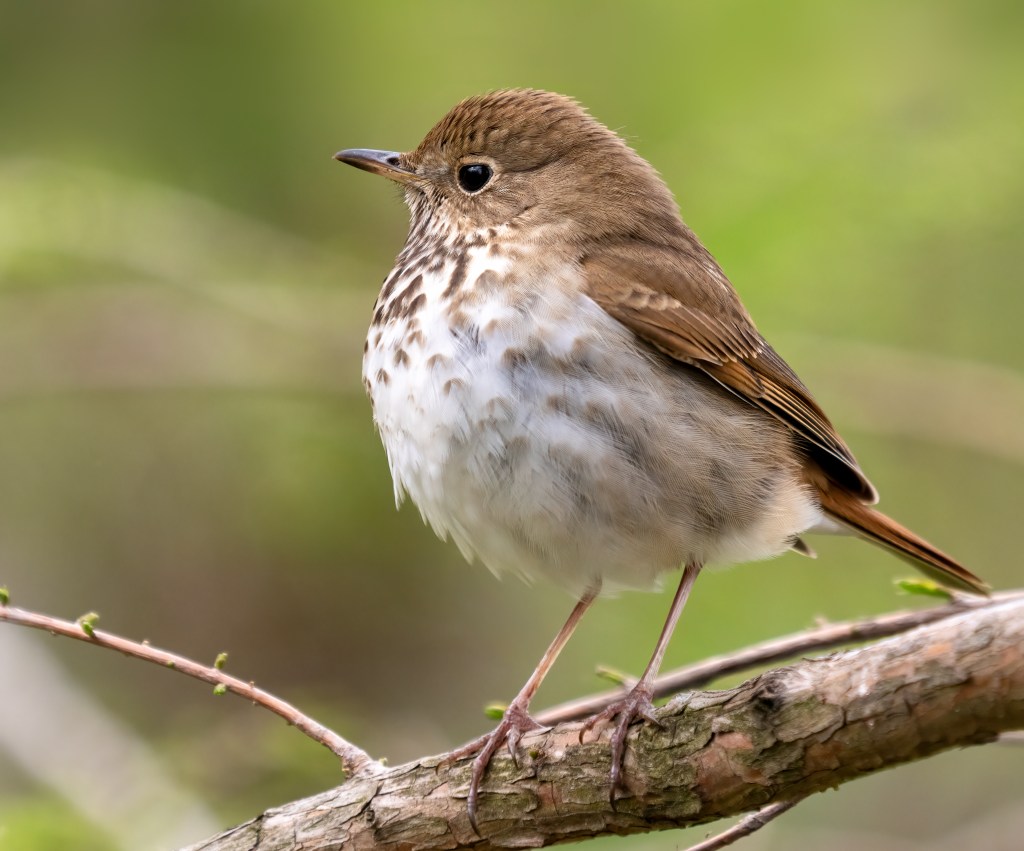
If you happen to find yourself in Peterborough, New Hampshire in the summer months, head west through town, over the Contoocook River, and north for a short way on High Street. There you will see a large plot of land dotted with a few dozen buildings, big and small, each tucked into its own little alcove in the New England woods. And if you happen to take a stroll through that land[*] and come upon one of the smaller buildings–the so-called Watson studio–take a quiet moment to listen. You might just hear what Amy Beach (1867-1944) heard in June of 1921: the fluty, beautiful song of the hermit thrush.
Beach was working as a resident of the MacDowell Colony, an artist’s retreat founded by the composer Edward MacDowell shortly before his death in 1908. His widow, Marian, expanded it with the help of generous donations to a 450-acre, 32-studio creative haven complete with theater, walking trails, and a library. It would support the work of some of the 20th century’s greatest artistic minds. Both Aaron Copland and Leonard Bernstein finished large musical projects while staying there. Willa Cather wrote Death Comes for the Archbishop and even Thornton Wilder put the finishing touches on Our Town while drawing on the kind of focus that only this secluded colony could offer.
As Amy Beach worked in solitude from her studio, she was enthralled by a little hermit thrush, whose music she described as “lonely but appealing.” She later wrote of the inspired moments that followed, “I took the songs down at the bird’s dictation, and oh, how hard I worked! Even the most expert stenographer would have had difficulty keeping up with him! I took them exactly, even as to key (except for a few intervals too small to be transcribed) and rewrote and corrected as he sang them over and over. Then I played them back to him and he would answer.” What a collaboration!
The Music
The music of Hermit Thrush at Eve (Op. 92, No. 1) begins quietly, rising from the bass register of the piano. Listen for the simple, plaintive melody that soon emerges high in the soprano as harmonies murmur below (0:40). The baritone responds with the same melody (1:00) until it gives way to the gentle but distinct ringing of a single high pitch, harmonies still undulating underneath (1:21). This single pitch begins to rise and rise, finally arriving on an exceedingly high E-flat, the “home” pitch of this particular piece (1:43). And then, it happens: the hermit thrush sings! Notice how the bird’s entrance works to brighten the mood of the piece, albeit briefly.
As all of this is repeated with more embellishment, the structure of the piece becomes clear: it is a large-scale conversation between the bird and the piano, whose accompaniment Beach designed to sound like “a vague, cloudy twilight, growing darker and darker.” By comparison, the birdsong is bright and clear. The piece threatens to end as it began, but as the sun sets, the lonely thrush has the final word.
Here is a wonderful recording, which was my first exposure to this haunting piece.
[*] Don’t actually do this. The land is private and rarely open to the public.
 Classical Connections
Leave a comment